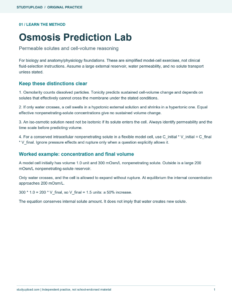
Osmosis Prediction Lab: Permeable solutes and cell-volume reasoning
Anatomy and Physiology I (HLTH 201) · 3 pages
Original worked problems and answer keys. Independent resources, not school-endorsed material.
Anatomy and Physiology I (HLTH 201) · 3 pages
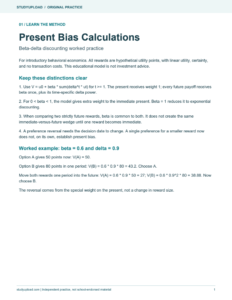
Behavioral Economics (ECON 370) · 3 pages
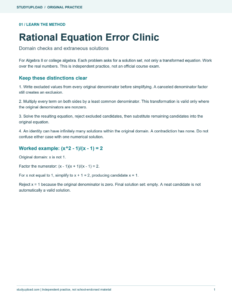
Algebra II · 3 pages
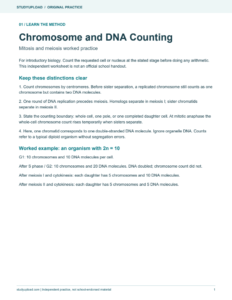
General Biology I (BIOL 101) · 3 pages
Choose a pack that matches a skill you are learning, attempt its questions, and use the explanations to decide what to study next. The library above offers separate actions for reading a resource online, downloading its PDF, and opening the available interactive practice. A PDF is useful when you want to annotate a page, work on paper, or keep the questions beside your own calculations. Preview the title and subject before opening it so that you spend your session on the right material.
These resources are independent practice materials. A familiar course name does not mean that a pack follows your instructor's syllabus, uses your textbook's notation, or covers an entire assessment. Start with your assignment instructions and learning objectives. Match a specific objective to a specific question type, then check whether the worked explanation uses assumptions that your class has introduced. Keep your course materials nearby for resolving differences.
A broad label such as biology or economics is a useful starting point, but the problem title gives you a better indication of scope. Identify the action that you need to perform: predict a result, compare two cases, check a possible solution, or explain a process. Write that action at the top of your working page. If the pack asks you to do something different, save it for a later session and choose a closer match.
Before attempting a whole pack, read one question without consulting its answer. Decide whether you understand its vocabulary and can identify the information given. If several terms are unfamiliar, review the relevant lecture section first. If you know the terms but cannot select an approach, the worked example may be a useful starting point. If you can outline an approach immediately, begin with an independent attempt and reserve the explanation for checking.
Record the resource title, the topic, and the question numbers you plan to attempt. This small record helps you return to an unfinished session without searching through several similar downloads. Avoid using the number of pages as a measure of difficulty. A short question may require several connected ideas, while a longer worked example may explain just one method in detail. Choose a manageable task that you can also review.
Put your answers on a separate sheet or in a separate note so that the answer key stays out of view while you work. Copy only the information needed to solve the problem, including units, conditions, or any stated restrictions. Leave space between questions for corrections. On a phone, reading the PDF in one window and recording your work on paper can be easier than switching repeatedly between the question and a small annotation box.
For a calculation, show the setup before entering numbers. For an explanation, write a complete sentence that connects the evidence to your conclusion. If you cannot finish, record the last step you can justify and describe what is missing. A note such as 'I can identify the quantities but cannot choose a relationship' gives you a more useful starting point for review than leaving the page blank or copying the answer.
Keep a simple distinction between an independent answer, an answer completed with a hint, and an answer copied after reading the explanation. All three can be part of studying, but they tell you different things about your readiness. Do not erase the record of a hint once you reach the correct result. It identifies a step to attempt independently when you return to the material.
Compare the reasoning as well as the final answer. Two solutions can reach the same result through different valid approaches. Look for the first point where your working and the explanation make different choices. Check the question wording before assuming that either method is wrong. You may have interpreted a condition differently, omitted a restriction, or used notation that needs translating into the language of your course.
Separate a reading mistake from a method mistake. Misreading a sign calls for a different correction than selecting an unsuitable model. Other useful categories include a missing definition, an unjustified assumption, arithmetic, units, and an incomplete explanation. Choose the category that best describes the first meaningful error, rather than assigning several labels to every line that follows from it.
Write a correction that tells your future self what to do. For example, 'list restrictions before simplifying' is more useful than 'be careful.' Add a short reason for the correction and a question you could answer to check it. If the explanation appears inconsistent or does not address your approach, consult your course reference or ask your instructor about the specific step. Treat an answer key as material to examine, not as a substitute for reasoning.
After reviewing an explanation, close it and reconstruct the solution in your own words. Include why each major step applies. If you can remember the final result but cannot explain the setup, return to the underlying definition or rule. You can also cover one step in the worked example and decide what belongs there before looking. Keep this guided reconstruction separate from a fully independent attempt in your notes.
On a later study day, retry a question that exposed a gap without looking at your earlier work. Compare the new attempt with the original. Ask whether the same obstacle appeared, whether your correction helped, and whether you can explain the reasoning more clearly. A repeated mistake is a reason to change the review activity. For example, practise identifying the relevant condition before doing another complete calculation.
When you create a variation, change one feature at a time and explain what you expect to change in the solution. Avoid changing values randomly if you do not know whether the new problem is still valid. An instructor-approved exercise can be a better transfer check. Do not judge understanding solely by speed or by recognition of a familiar answer; include a question that asks you to justify the method.
A compact error log can use four headings: question, first obstacle, correction, and next check. Keep each entry short enough to scan before another session. Record successful strategies too, especially when you solved a question independently after needing help earlier. At the end of the session, choose one next action, such as revisiting a definition or retrying two marked questions, rather than adding an entire subject to a vague study list.
Use the online reading action when you want to inspect a resource before saving it. Use Download PDF when you want a local copy; your browser may open a PDF viewer before offering its save control. After saving, check that the file opens and that the page text is readable at a comfortable zoom. Keep the original file separate from an annotated version if you want a clean copy for another attempt.
When a diagram or equation is difficult to read on a small screen, enlarge the page or use a larger display instead of guessing at a symbol. If you print a pack, preview the pages for clipped margins and check that any distinctions still make sense without colour. Keep your calculations together with the resource title so that loose answer pages remain understandable when you return to them.
Carnegie Mellon's Eberly Center describes retrieval practice as bringing information to mind and highlights feedback when checking answers. Its learning principles also connect goal-directed practice with targeted feedback. These references support the general study approach described here; they do not review or endorse the individual packs in this library.
For a topic beyond the available packs, browse study documents and compare the resource description with your objective. Explore related subjects and courses for a different starting point, or use the school directory to look for school-specific material. Titles and course labels are search aids, so check the document itself before relying on it.
Choose a title that matches one specific learning objective. Read a sample question, check the vocabulary and assumptions against your course, and select a manageable set that leaves time to review your answers.
Try independently when you know enough to begin. If you need an example, study it and then close the explanation before reconstructing the reasoning. Record any hints so you know what to retry without help.
No. These are independent practice resources, and a course label does not establish syllabus coverage or school endorsement. Compare the questions with your current learning objectives and your instructor's assessment guidance.
Find the first step where your reasoning needs correction, write a specific next action, and retry without the answer visible. If the explanation remains unclear, bring the exact question and your working to your instructor.
If your corrections become a clear explanation, organise them into notes that another student can follow. Include the topic, definitions, assumptions, and enough working to make the reasoning understandable. Check that the material is yours to share and remove personal information. Upload your notes when they are ready for classmates to read.